
Medical Disclaimer: This article is for informational purposes only and does not constitute medical advice. Always consult a qualified healthcare professional before starting any supplement regimen or making changes to your health routine. The information presented here is based on published research but should not replace professional medical guidance.
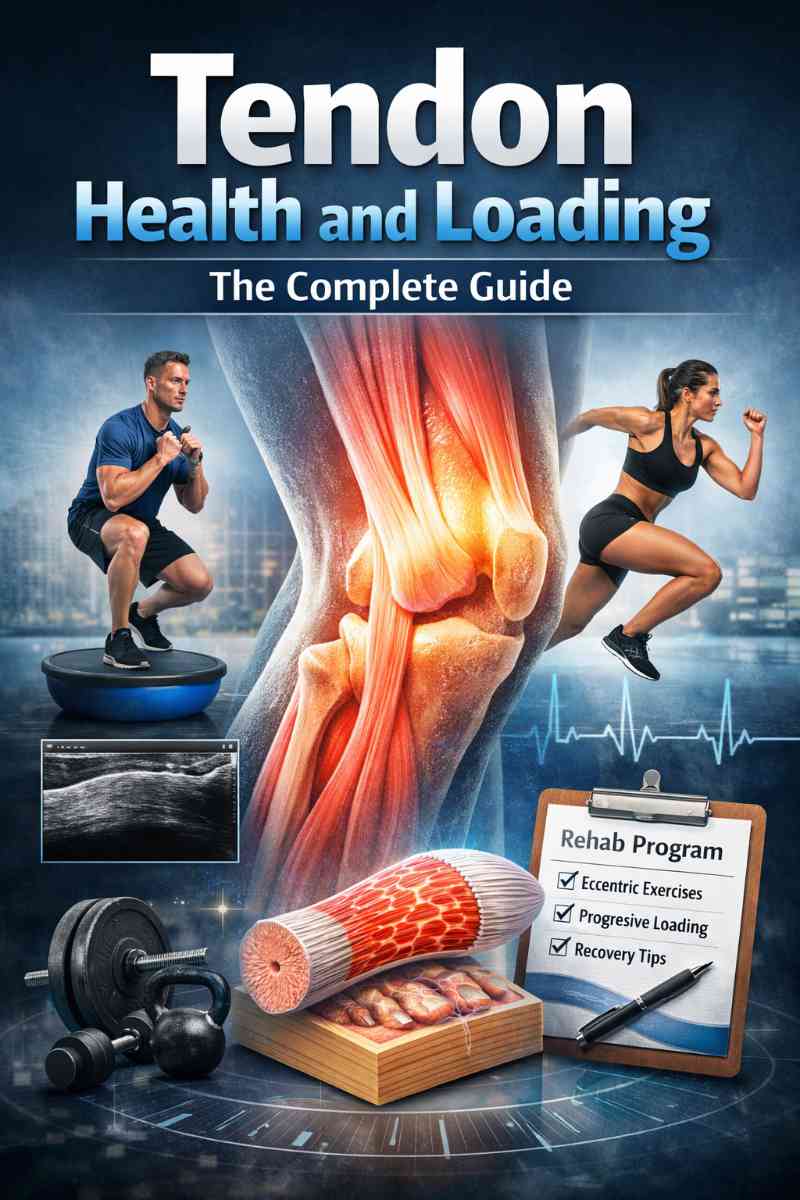
There are even whole systems of exercises within some of the more esoteric Kung Fu systems dedicated to maintaining your tendons.
Of everything I've researched in the mobility and longevity space, tendon health is the area where the gap between what the evidence actually shows and what most people do is widest.
Most advice on stiff or painful tendons still centres on rest, ice, and waiting it out. The research has moved a long way past that — and the newer picture is both more specific and more actionable than "just rest it."
This guide covers what actually changes in tendon over the years, why the standard rest-based approach to tendon pain often makes things worse rather than better, and the loading protocols with genuine trial evidence behind them.
Why Tendons Age Differently From Muscle
Tendons and muscle look like they belong to the same system — they're attached to each other, after all — but they age on very different timelines, for a straightforward structural reason: blood supply.
Muscle is richly vascularised. Tendon is not. The collagen-dense structure that makes tendon so good at transmitting force also makes it relatively starved of the blood flow that carries the nutrients and repair signals muscle relies on. This is precisely why a pulled muscle heals in weeks while a tendon injury can drag on for months, and why tendon problems become more common — not less — as we age.
With age, three specific changes occur in tendon tissue: the collagen fibres become less organised (imagine a tightly woven rope gradually loosening into something closer to felt), water content declines, and the tissue's capacity to store and return elastic energy — the "spring" that makes movement feel effortless — reduces. None of this is inevitable decline in the way it's often framed. It's disuse-accelerated, and it responds to the right kind of loading at any age.
The key distinction: Muscle adapts to a wide range of stimuli — walking, general activity, almost anything. Tendon adapts almost exclusively to direct mechanical loading. This is the single most important fact in this entire guide, and it's why generic "stay active" advice consistently underperforms for tendon-specific problems.
The Loading Principle: What the Research Shows
For decades, the standard medical response to tendon pain was rest, anti-inflammatories, and — if that failed — injection or surgery. The research over the last 25 years has substantially overturned this model. Tendons that are progressively and appropriately loaded don't just tolerate movement better; the loading itself appears to drive structural remodelling of the tendon.
The foundational study here is Alfredson and colleagues' 1998 trial of heavy-load eccentric calf training for chronic Achilles tendinosis.[1] Fifteen recreational athletes with long-standing symptoms that had failed to respond to conventional non-surgical treatment underwent a 12-week eccentric loading programme. All fifteen returned to full pre-injury running activity. This was a small trial, but it reshaped how tendon rehabilitation is approached, and the finding has since been replicated and extended many times over.
The mechanism appears to be genuine structural adaptation, not simply symptom masking: loaded tendons show improved collagen fibre alignment and — in imaging studies — measurable reductions in the disorganised tissue characteristic of tendinopathy. Rest, by contrast, does nothing to reverse this disorganisation; it simply removes the pain trigger temporarily, which is a large part of why tendon problems treated with rest alone have such high recurrence rates once activity resumes.
Isometric Loading for Pain Relief
If you take one practical tool from this guide, make it this one. Isometric loading — holding a muscle contraction at a fixed joint angle, without movement — has one of the most immediately useful evidence bases in all of tendon research: it reduces tendon pain, right now, within minutes.
Rio and colleagues' 2015 study is the key trial here.[2] In a group of athletes with patellar tendinopathy, a single bout of isometric loading (five sets of 45-second holds at 70–80% of maximum effort) produced a significant reduction in tendon pain that was still present 45 minutes later — while an equivalent bout of standard isotonic (moving) exercise did not produce the same sustained effect. The researchers also found reduced cortical inhibition, suggesting the pain relief isn't just local — it involves a genuine change in how the nervous system is processing signals from the tendon.
| Protocol Element | Guidance |
|---|---|
| Contraction intensity | 70–80% of maximum effort |
| Hold duration | 30–45 seconds per hold |
| Sets | 4–5 |
| Rest between sets | 60–90 seconds |
| Frequency | Once or twice daily, particularly useful before activity that normally provokes pain |
This makes isometric loading a genuinely practical tool: it's simple, requires no equipment beyond something to push or pull against, and unlike painkillers, it appears to work through a mechanism that also supports the longer-term structural adaptation covered in the next section — rather than simply masking the problem.
Heavy-Slow-Resistance vs Eccentric Training
Eccentric loading — lengthening a muscle under tension, such as slowly lowering the heel below a step edge — was the original evidence-backed tendon rehabilitation protocol, built directly on Alfredson's 1998 findings. It remains extremely well supported. But it isn't the only option, and for many people it isn't the easiest one to stick with.
Beyer and colleagues directly compared eccentric training against heavy-slow-resistance (HSR) training — conventional, slow, controlled resistance exercise through the full range of motion, both lengthening and shortening — in a randomised controlled trial of 58 patients with chronic Achilles tendinopathy.[3] Both approaches produced equally good, lasting clinical improvement at 12 weeks and at one year. The HSR group reported somewhat higher satisfaction at the 12-week mark, plausibly because the full-range, both-directions movement pattern feels more like normal, intuitive exercise than the eccentric-only protocol.
My take: Given the evidence shows equivalent outcomes, I generally recommend heavy-slow-resistance training as the practical default — three sets of a slow, controlled, full-range movement (roughly three seconds down, three seconds up), three times per week, for the relevant tendon. It's easier to learn correctly and easier to sustain than a strict eccentric-only protocol, and the research doesn't show a meaningful outcome penalty for choosing it.
Building a Tendon-Loading Practice
Whether you're addressing an existing niggle or trying to protect healthy tendons as you age, the same basic structure applies:
- If a tendon is currently painful: start with isometric holds (above) to manage pain, then transition into heavy-slow-resistance loading for the specific tendon as pain allows — typically within one to two weeks.
- If you're training preventatively: fold slow, controlled, full-range resistance work for major tendon groups (Achilles, patellar, rotator cuff, wrist extensors) into your regular strength training — see our Strength Training for Longevity guide for the broader framework this sits inside.
- Expect a slow timeline. Alfredson's original protocol ran 12 weeks before assessing outcomes, and Beyer's comparison trial followed patients out to a full year. Tendon adapts on the order of months, not the two-to-four-week timeline typical of muscle strength gains — plan accordingly and don't judge the approach as failing after two or three weeks.
Common Mistakes
Resting completely and waiting for pain to disappear. This is the single most common and most counterproductive response to tendon pain. Rest removes the pain trigger but does nothing to reverse the underlying tissue disorganisation — which is why symptoms so reliably return once normal activity resumes.
Loading too aggressively, too soon. The flip side of the first mistake. A tendon that has been under-loaded for months cannot suddenly tolerate full training volume. Both Alfredson's and Beyer's protocols build load progressively over 12 weeks — that pacing is part of what makes them effective and safe.
Stopping as soon as pain improves. Pain relief from isometric loading or the early weeks of a loading programme reflects a genuine but partial change — it is not the same as complete structural remodelling, which continues for months. Stopping early is a common reason for relapse.
Frequently Asked Questions
Should I rest a painful tendon or keep loading it?
The evidence generally favours appropriate loading over complete rest. Rest reduces pain temporarily but does not address the underlying tissue disorganisation, and symptoms typically return once normal activity resumes. The practical approach is to reduce load to a tolerable level — isometric holds are a good starting point — rather than stopping entirely, then progressively rebuild loading as symptoms allow. If pain is severe or you're unsure, a physiotherapist can help calibrate the right starting point for your specific situation.
How quickly does isometric loading relieve tendon pain?
In the Rio et al. 2015 trial, a single bout of isometric loading produced significant pain reduction that was still measurable 45 minutes later. Many people notice a difference within the same session. This makes it a genuinely useful tool to use shortly before an activity that normally provokes tendon pain, not just as a long-term rehabilitation strategy.
Is eccentric training or heavy-slow-resistance training better?
Head-to-head trial evidence shows equivalent long-term outcomes between the two approaches. Heavy-slow-resistance training tends to be easier to learn and sustain because it uses a more natural, full-range movement pattern, and patients in the comparison trial reported somewhat higher satisfaction with it in the short term. Either is a reasonable choice; consistency matters more than which specific protocol you pick.
How long does tendon rehabilitation actually take?
Plan on a minimum of 12 weeks of consistent loading before expecting substantial change, based on the landmark trials in this area. Meaningful pain relief often arrives sooner — sometimes within days for isometric protocols — but that early relief reflects partial change, not complete structural remodelling. Continuing the loading programme well past the point symptoms improve is important for durable results.
Can tendon loading help even if I don't currently have pain?
Yes. Because tendon adapts specifically to mechanical loading rather than general activity, regularly including slow, controlled, full-range resistance work for major tendon groups as part of ordinary strength training is a reasonable preventive strategy — particularly given how much more slowly tendon heals once a problem develops compared with preventing one in the first place.
Citations
- Alfredson H, Pietilä T, Jonsson P, Lorentzon R. Heavy-Load Eccentric Calf Muscle Training For the Treatment of Chronic Achilles Tendinosis. Am J Sports Med. 1998;26(3):360–366. PMID: 9617396
- Rio E, Kidgell D, Purdam C, et al. Isometric exercise induces analgesia and reduces inhibition in patellar tendinopathy. Br J Sports Med. 2015;49(19):1277–1283. PMID: 25979840
- Beyer R, Kongsgaard M, Hougs Kjær B, Øhlenschlæger T, Kjær M, Magnusson SP. Heavy Slow Resistance Versus Eccentric Training as Treatment for Achilles Tendinopathy: A Randomized Controlled Trial. Am J Sports Med. 2015;43(7):1704–1711. PMID: 26018970