
Medical Disclaimer: This article is for informational purposes only and does not constitute medical advice. Always consult a qualified healthcare professional before starting any supplement regimen or making changes to your health routine. The information presented here is based on published research but should not replace professional medical guidance.
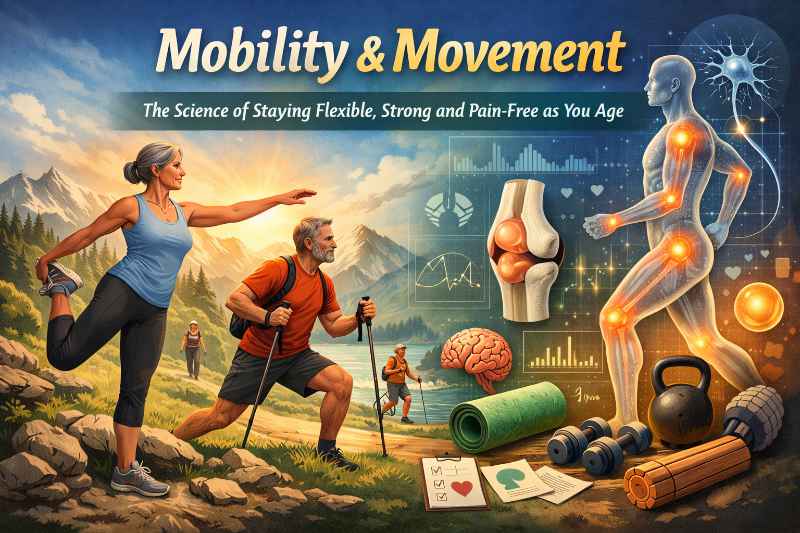
Ask most people what "ageing" feels like day to day, and they won't mention telomeres or NAD+. They'll mention their back taking ten minutes to wake up. Checking a blind spot by turning the whole body instead of the neck. Stairs becoming something you think about rather than something you simply do.
For years, this kind of stiffness was treated as an inevitable, essentially mysterious decline, the price of birthdays. That view hasn't aged well.
We now understand a great deal about why joints, tendons and muscles stiffen with age, and more usefully, which interventions measurably slow, and in several cases reverse, that process. Some of this research overlaps directly with the Hallmarks of Aging covered in our Science guide: sarcopenia and tendon degeneration are not separate from cellular ageing, they are cellular ageing, expressed in the tissues you use to open a jar.
This guide covers what the evidence actually supports: the biology of why mobility declines, the interventions with genuine trial data behind them, and how to build a realistic weekly practice — rather than another generic "10 stretches for seniors" list with no mechanism behind it.
How Your Joints, Muscles and Tendons Actually Age
Mobility loss isn't one process. It's three overlapping ones, ageing at different rates and responding to different interventions — which is exactly why generic advice ("just stretch more") underperforms.
Sarcopenia — muscle loss. Skeletal muscle mass declines by roughly 3–8% per decade from around age 30, with the rate accelerating to as much as 15% per decade after 60.[1] Muscle isn't just about strength; it's the primary support structure for every joint it crosses. As it weakens, joints absorb loads they were never designed to carry alone.
→ Read: Strength Training for Longevity
Tendon and ligament ageing. Tendons and ligaments have a far poorer blood supply than muscle, which is precisely why they heal more slowly and stiffen earlier. With age, collagen fibres within tendon become less organised and less elastic, reducing the tissue's ability to store and return energy efficiently — part of why movement can start to feel effortful rather than springy. Unlike muscle, tendon adapts almost exclusively to mechanical loading rather than to general activity, which is why the interventions below are specific rather than generic.
Loss of range through disuse. This is the most reversible piece, and the most commonly ignored. A joint that only ever operates in a narrow daily range — hands at keyboard height, hips at ninety degrees in a chair — gradually loses the rest of its range, independent of strength or tendon health. This is a "use it or lose it" mechanism in the most literal sense, and it responds quickly to targeted mobility work, often faster than strength or tendon changes.
Underneath all three, the same cellular processes from our Hallmarks of Aging framework are at work — mitochondrial dysfunction reducing muscle energy output, chronic low-grade inflammation ("inflammaging") accelerating cartilage breakdown, and cellular senescence contributing to the loss of tissue repair capacity. Movement is one of the few interventions that measurably pushes back against several hallmarks simultaneously, which is a large part of why it outperforms almost everything else in this space.
Tier 1: Strong Evidence
These interventions have substantial trial and mechanistic evidence specifically for joint, muscle and tendon ageing. They form the foundation of an evidence-based mobility practice.
Resistance / Strength Training
The single most evidence-backed intervention for age-related muscle and joint decline. Progressive resistance training preserves — and can partially rebuild — muscle mass, bone density and tendon stiffness (in the good, springy sense) at any age, including in people starting in their 70s and 80s.
It also improves insulin sensitivity and metabolic rate, which is part of why it sits at the centre of both mobility and longevity research.
Limitation: requires progressive loading to keep working — the same routine indefinitely produces diminishing returns — and technique matters more than in most other interventions on this list.
→ Read the full Strength Training for Longevity guide
Progressive Tendon Loading
Tendons respond to a narrower stimulus than muscle: mechanical load, applied progressively and consistently. Research into tendinopathy rehabilitation — heavy-slow-resistance protocols and sustained isometric loading in particular — has shown measurable improvements in tendon pain and function.
A widely cited 2015 trial by Rio and colleagues found that a single bout of isometric loading produced significant, sustained pain reduction in patellar tendinopathy within 45 minutes.[2] The same loading principle that rehabilitates an injured tendon also appears to protect a healthy one from age-related stiffening.
Limitation: this is patient work. Tendon adapts over months, not weeks, and overloading a tendon too quickly — the classic "weekend warrior" pattern — is itself a leading cause of tendon injury in older adults.
→ Read: The Complete Guide to Tendon Health and Loading
Zone 2 / Aerobic Movement for Joint Nutrition
Cartilage has no blood supply of its own. It is nourished almost entirely by the mechanical pumping action of joint movement, which circulates synovial fluid through the tissue. Regular low-to-moderate aerobic movement — walking, cycling, swimming — is one of the simplest and best-evidenced ways to keep this nutrient exchange active, alongside its well-known cardiovascular and mitochondrial benefits.
→ Read the full Zone 2 Cardio Guide
Daily Range-of-Motion Work
Distinct from both strength and aerobic training: dedicated, low-load movement of a joint through its full available range, performed frequently. Because disuse-related range loss is a "use it or lose it" mechanism, this is also one of the fastest-responding interventions — many people notice measurable range improvements within two to three weeks of daily practice, well before strength or tendon adaptations arrive. It is also the gentlest entry point for anyone currently doing no structured movement at all.
→ Read: The Daily Mobility Routine — What the Research Says About Frequency vs Intensity
Tier 2: Good Supporting Evidence
These approaches have real, published evidence — generally smaller trials, or evidence that is strong for some outcomes (pain, balance, falls) and more modest for others (strength) — but are well worth including in a rounded practice.
Traditional Low-Impact Systems: Tai Chi and Qigong
Of everything in this tier, Tai Chi has the most substantial research base. A 2016 randomised controlled trial published in the Annals of Internal Medicine compared Tai Chi directly against standard physical therapy in people with knee osteoarthritis and found Tai Chi produced equivalent improvements in pain and physical function, with additional benefits for depression and quality of life.[3]
Separately, a substantial body of research — including a landmark 2005 randomised controlled trial by Fuzhong Li and colleagues at the Oregon Research Institute, involving 256 adults aged 70–92 — has found a three-times-weekly Tai Chi programme significantly reduces the number of falls, fall risk and fear of falling in older adults.[4] This is one of the outcomes with the highest real-world stakes in this entire field.
What makes these traditional systems interesting mechanistically is that they combine several Tier 1 principles at once — range-of-motion work, low-level isometric loading, balance training and slow, controlled movement — inside a single, sustainable daily practice. This is also the tradition our companion guide, Chinese Mobility Secrets, draws on directly: a set of restorative exercises developed and refined by Chinese martial artists over centuries of practical necessity, organised into a 15-minute daily routine.
Limitation: trial quality varies, and much of the research uses instructor-led group classes rather than solo home practice — though the mechanisms involved (loading, range, balance) are the same regardless of setting.
→ Read: Chinese Mobility Secrets — the complete traditional routine
Balance Training
Distinct from Tai Chi as a standalone intervention: structured balance work (single-leg stands, dynamic weight shifts, unstable-surface training) has its own evidence base for fall reduction, particularly in adults over 65. Falls are a leading cause of injury-related disability in older age, which makes this one of the highest-stakes, if least glamorous, items on this list.
Yoga
Combines flexibility, isometric strength and a mind-body/breathing component. Evidence for pain and function outcomes in osteoarthritis and chronic low back pain is generally positive, though study quality and style variation (restorative vs power vs hot yoga) make it harder to generalise than Tai Chi. A gentle, slow-paced style is the better-evidenced choice for joint-focused practice.
Self-Myofascial Release (Foam Rolling)
Popular and pleasant, with modest but genuine evidence for short-term range-of-motion improvement and perceived muscle soreness reduction. It is not a substitute for the interventions above, but a reasonable, low-risk addition — particularly as a warm-up before loaded work.
Building Your Weekly Practice
The research above points to a practice built from four ingredients, not one. A realistic weekly structure:
| Day | Focus | Duration |
|---|---|---|
| Mon / Wed / Fri | Resistance training | 30–45 min |
| Daily | Range-of-motion routine | 15 min |
| Tue / Thu / Sat | Zone 2 aerobic movement | 30–45 min |
| 2–3×/week | Balance work or Tai Chi/Qigong | 15–20 min |
The daily range-of-motion piece is the easiest to sustain and, for most people starting from a stiff, under-moved baseline, the one that delivers the earliest noticeable win — which matters for adherence to everything else on this list.
A ready-made daily routine. If you'd rather follow a structured sequence than assemble your own, Chinese Mobility Secrets lays out a complete 15-minute daily practice — back, neck, shoulders, hands, hips, knees and ankles, in a deliberate order — built on the Tier 1 and Tier 2 principles above. Read the guide →
Common Mistakes
Using static stretching as a substitute for strength work. Stretching improves range temporarily; it does very little for the underlying tendon and muscle weakness that caused the range to close down in the first place. Useful as a warm-up, insufficient as a strategy on its own.
The weekend-warrior pattern. Every joint runs something close to a repair budget: everyday micro-damage on one side, the body's repair capacity on the other. A single heavy weekend session after a sedentary week can outspend that budget in an afternoon — this is a leading cause of soft-tissue injury in people who are otherwise reasonably active. Frequent and moderate consistently outperforms occasional and intense.
Treating joint pain reactively. Most people begin mobility work only after a joint starts complaining — by which point disuse-related range loss and some degree of tendon deconditioning have usually already set in. The same interventions work far better, and far faster, as prevention than as repair.
Large, forceful range-of-motion work on joints built for small ranges. The knee, in particular, is fundamentally a hinge with only limited tolerance for lateral movement. Large, forced circular motions at the knee push the joint into territory its ligaments were never designed to protect, and can cause the very damage the exercise was meant to prevent. Range-of-motion work should always match the joint's actual design.
Skipping the warm-up. Loading a cold tendon is a well-established risk factor for tendon injury. A few minutes of low-load movement before resistance or aerobic work is not an optional extra polish — it's part of the intervention.
Frequently Asked Questions
Can you actually regain lost mobility, or is decline inevitable?
Meaningfully, yes — particularly the disuse-related component. Range of motion lost through underuse is among the most reversible forms of age-related decline, often improving within weeks of consistent practice. Muscle mass and tendon quality respond more slowly, over months, but the research on resistance training and tendon loading in older adults — including people starting in their 70s and 80s — consistently shows real, measurable gains rather than merely slowed decline.
Is walking enough, or do I need strength training too?
Walking is genuinely valuable — for cardiovascular health, cartilage nutrition and general movement — but it does not provide sufficient mechanical loading to meaningfully build or preserve muscle and tendon strength. The evidence is clear that both are needed: aerobic movement and resistance training address different mechanisms, and neither substitutes for the other.
What does the evidence actually say about Tai Chi and Qigong?
Stronger than most people assume, particularly for pain, function and fall prevention. A 2016 trial in the Annals of Internal Medicine found Tai Chi produced pain and function improvements in knee osteoarthritis equivalent to standard physical therapy, and a substantial separate body of research — including a well-known 2005 trial of 256 older adults — links regular Tai Chi practice to meaningfully reduced fall risk. It is not a replacement for resistance training, but it is one of the better-evidenced complementary practices available.
Is stretching or strength training better for a stiff joint?
For lasting change, strength training and progressive loading outperform stretching. Stretching provides temporary range improvements by reducing muscle tension; it does not address the tendon and muscle weakness that usually underlies chronic stiffness. The two work best combined — a brief warm-up stretch or mobility sequence, followed by loaded work.
How long before mobility work makes a noticeable difference?
Expect a rough order: warmth and looser movement within the first session or two; measurable range-of-motion improvements within two to three weeks of daily practice; noticeable strength and functional gains (stairs, getting up from a chair) within six to eight weeks; and the deeper tendon and structural adaptations that make the change durable over a full three months. This is broadly consistent with what tendon-loading and resistance-training research shows about adaptation timelines in older adults.
References
- Age-related skeletal muscle loss of approximately 3–8% per decade from age 30, accelerating to as much as 15% per decade after 60. See Cleveland Clinic: Sarcopenia.
- Rio E, Kidgell D, Purdam C, et al. "Isometric exercise induces analgesia and reduces inhibition in patellar tendinopathy." Br J Sports Med. 2015;49(19):1277–1283. PubMed: 25979840
- Wang C, Schmid CH, Iversen MD, et al. "Comparative Effectiveness of Tai Chi Versus Physical Therapy for Knee Osteoarthritis: A Randomized Trial." Ann Intern Med. 2016;165(2):77–86. DOI: 10.7326/M15-2143
- Li F, Harmer P, Fisher KJ, et al. "Tai Chi and fall reductions in older adults: a randomized controlled trial." J Gerontol A Biol Sci Med Sci. 2005;60(2):187–194. PubMed: 15814861
Last reviewed: 16 Jul 2026 by Steve Butler, Health Writer & Longevity Researcher